

CEER Unveils First Saudi-made EV Car


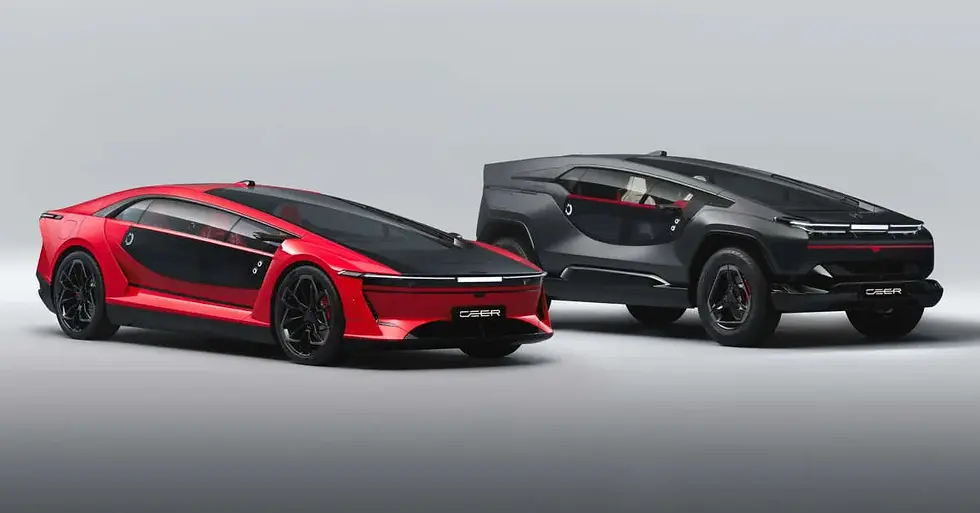
For Saudi Arabia, September 21, 2026, marked the point at which a long-running automotive ambition moved from plans and prototypes to an actual vehicle. At an unveiling ceremony in Jeddah, Crown Prince Mohammad Bin Salman launched the first vehicles from CEER, the Kingdom’s homegrown automotive brand established by the Public Investment Fund (PIF).
Called EXOBOT, the first two models are an electric sedan and SUV that will form the foundation of a planned seven-vehicle lineup. The cars are expected to enter the Saudi market in early 2027, with five additional models planned through 2030. CEER says the future range will extend into compact and midsize segments and will eventually include different powertrain technologies rather than being limited exclusively to battery-electric vehicles.
The unveiling represents more than the arrival of another EV manufacturer. CEER is one of the most visible pieces of Saudi Arabia's broader attempt to establish an automotive industry inside the Kingdom — an ambition that has been pursued through several different approaches over decades.
The company was created in 2022 by PIF in partnership with Foxconn, to develop a Saudi automotive brand while simultaneously building the manufacturing, engineering and supply-chain infrastructure needed to support it. The EXOBOT program is therefore intended to do more than put a new badge on Saudi roads: it is designed to become part of a much larger industrial ecosystem.
Production is being developed around the CEER Manufacturing Complex in King Abdullah Economic City, within the King Salman Automotive Cluster. The project sits alongside other major automotive investments in the area, including Lucid's manufacturing operation and the Hyundai-PIF joint venture.
CEER estimates that the project could contribute more than SAR30 billion to Saudi Arabia's GDP and more than SAR80 billion to the Kingdom's trade balance by 2034, while creating direct and indirect employment. Those targets place the company within the economic diversification objectives of Vision 2030, where manufacturing is expected to play a larger role in reducing the country's dependence on oil.
From PIF Project to Saudi Automotive Brand — 2022

CEER was launched in 2022 as Saudi Arabia's first automotive brand, with PIF positioning the company as part of its effort to develop a domestic automotive sector.
Rather than beginning with a conventional model designed primarily for mass production, CEER was conceived around a broader industrial strategy. International companies would provide technology, engineering and manufacturing expertise while Saudi Arabia developed the infrastructure, workforce and supplier network around them.

Foxconn became a central partner in the project, contributing to the vehicles' electrical architecture, while BMW has provided engineering support. International automotive suppliers including Lear, Benteler, Shin Young and Fangxin have also established or expanded operations in Saudi Arabia to support the emerging supply chain.
The company has gradually expanded its ambitions since its creation. What began as a dedicated EV manufacturer has evolved into a broader automotive program that will eventually include plug-in hybrids and combustion-engine vehicles alongside battery-electric models.
That strategy reflects a recognition that establishing an automotive industry requires more than developing an electric vehicle. It requires a market, suppliers, manufacturing capacity, engineering expertise and the ability to produce different kinds of vehicles at commercially viable volumes.
But CEER is far from being Saudi Arabia's first attempt.
Saudi Arabia's Automotive Manufacturing Journey
Mercedes-Benz & Juffali — 1950s–1977

Saudi Arabia's relationship with the global automotive industry dates back to the 1950s, when Juffali entered the sector through its association with Mercedes-Benz. Juffali became the German company's authorized distributor in Saudi Arabia in 1959, establishing one of the Kingdom's earliest major relationships with an international automaker.
The relationship eventually progressed beyond distribution.
In 1974, the National Automobile Industry Company was established as a joint venture involving Daimler and E.A. Juffali & Brothers to assemble Mercedes-Benz commercial vehicles locally. By 1977, the first Mercedes-Benz trucks had been assembled in Jeddah.
The operation became an important early example of vehicle manufacturing in the Kingdom. It demonstrated that Saudi Arabia could support local assembly while integrating an international automotive manufacturer into its industrial base.
But this was fundamentally different from creating a Saudi car brand. The technology, brand and vehicles remained those of an established international manufacturer.
Ghazal-1 — 2010
The next milestone was considerably more ambitious.
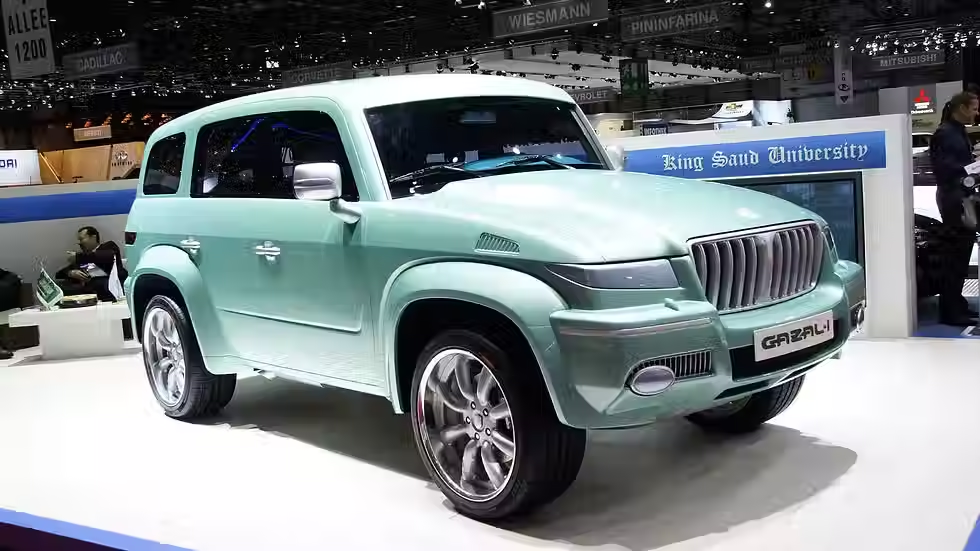
In 2010, King Saud University unveiled the Ghazal-1, a Saudi-designed SUV project that was presented as a demonstration of the Kingdom's ability to develop its own vehicle.
The project attracted considerable attention and national enthusiasm, but the Ghazal-1 never progressed into commercial production. The prototype relied heavily on an existing Mercedes-Benz G-Class platform, while the project lacked the manufacturing infrastructure, investment, and commercial partnerships required to turn the concept into a mass-produced vehicle.
Ghazal-1 consequently became an example of the difference between designing a vehicle and establishing an automotive industry capable of producing one.
The project proved that Saudi engineering talent could participate in vehicle development. What remained unresolved was how to turn that capability into a commercially sustainable manufacturing operation.
SNAM and the Uruk — 2016
Six years later, Saudi Arabia attempted another route.
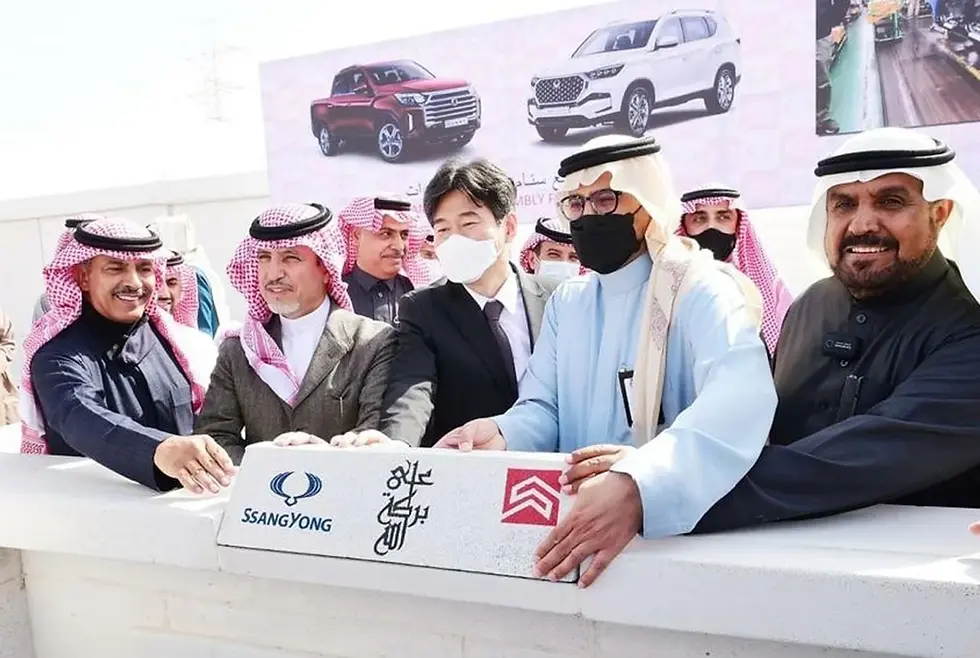
The Saudi National Automotive Manufacturing Company, or SNAM, was launched in 2016 with the ambition of establishing a national automotive manufacturer and developing a locally based supply chain.
Its proposed Uruk SUV was intended to be a Saudi-developed vehicle suited to the Kingdom and the wider region. Unlike a one-off university prototype, SNAM's ambitions centered on creating an industrial operation involving manufacturing, engineering, suppliers and assembly.
Lucid — 2023

The electric-vehicle era brought a different kind of opportunity.
Saudi Arabia became a major investor in Lucid Motors through PIF, eventually helping bring the American EV manufacturer to King Abdullah Economic City.
In September 2023, Lucid opened its first international manufacturing facility in Saudi Arabia. The KAEC facility began with semi-knocked-down assembly of Lucid Air vehicles, initially operating at a capacity of around 5,000 vehicles annually, with plans for the site eventually to reach much larger production volumes.
Lucid's arrival was significant because it moved Saudi Arabia's automotive ambitions beyond prototypes and commercial-vehicle assembly. For the first time, a major modern passenger-car manufacturer was establishing a dedicated production operation inside the Kingdom.
It also helped turn KAEC into the center of Saudi Arabia's emerging automotive industry.
Hyundai — 2024–Present

Hyundai became another major component of that strategy through a joint venture with PIF.
Under the agreement, PIF holds a 70 percent stake while Hyundai owns the remaining 30 percent. The planned manufacturing facility is designed to produce around 50,000 vehicles annually, including both internal-combustion and electric vehicles.
The project reflects the broader direction of Saudi industrial policy: combine international automotive expertise with Saudi investment and local manufacturing infrastructure to gradually build a domestic ecosystem rather than relying exclusively on imported vehicles.
Together, the Hyundai and Lucid projects helped create the industrial environment into which CEER would eventually arrive.
CEER Returns to the Forefront
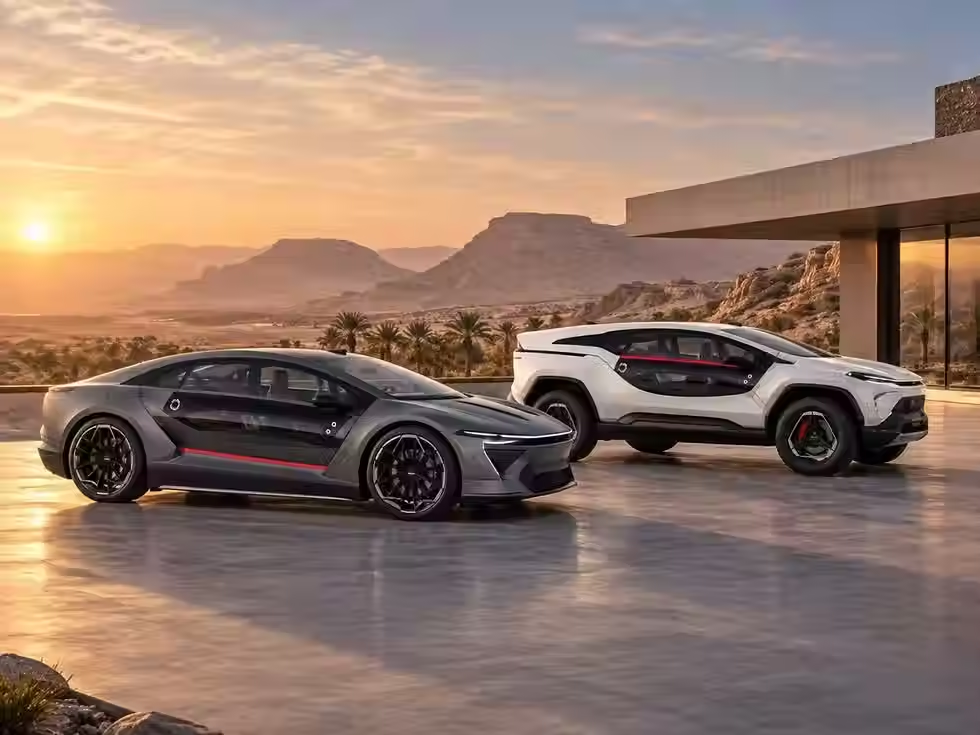
That history makes the EXOBOT more significant than its headline performance figures might initially suggest.
CEER is attempting to solve several of the problems that confronted previous Saudi automotive projects simultaneously. It has substantial financial backing through PIF, an international technology and engineering network, a dedicated manufacturing facility, an expanding supplier base and a multi-model product strategy.
The company is also taking a more deliberate approach to localization. Its stated ambitions include increasing the share of Saudi-made components and developing local engineering and manufacturing talent, making the eventual success of CEER less dependent on simply assembling imported components.
The EXOBOT itself is designed and engineered in Saudi Arabia, with CEER saying its design language draws from the Kingdom's landscape and cultural heritage. References have included Najdi architecture, Red Sea coral formations and Sadu weaving.
And visually, CEER has made little attempt to make its first car conventional.
Both EXOBOT models are exceptionally large, with the sedan measuring approximately 5.26 metres long and the SUV just over five metres. Their most immediately striking feature is the windshield, which stretches dramatically from the roof toward the front of the vehicle, creating an almost uninterrupted glass surface. CEER says the windshield measures around 2.4 metres, making it the largest fitted to a production vehicle.
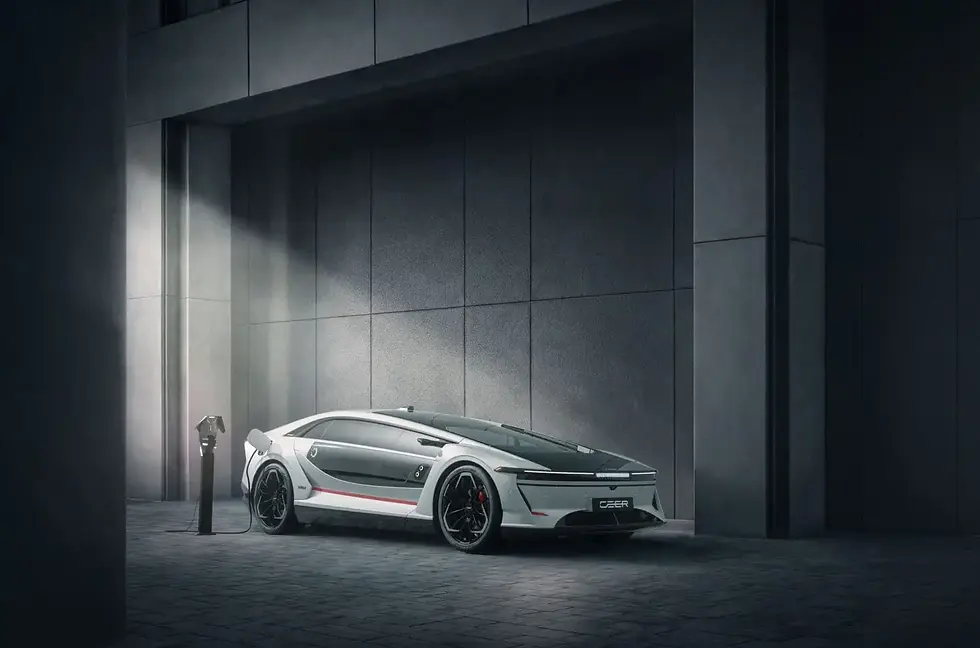
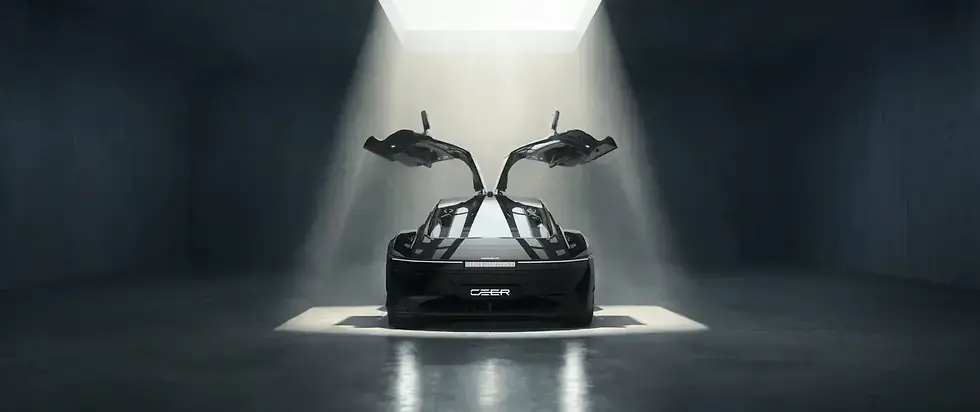
The cars also abandon conventional doors in favor of upward-opening gullwing-style panels that CEER calls "Shahin Wing Doors," referencing the peregrine falcon. The sedan sits extremely low and wide, while the SUV adopts a taller, more muscular stance.
Inside, the same futuristic approach continues. A 48-inch display spans much of the dashboard, joined by a central infotainment screen and rear passenger display. A yoke-style steering wheel, AI-powered voice assistance, over-the-air software updates and advanced driver-assistance technology are among the features planned.
Underneath the design is equally serious hardware. The highest-output configuration uses three electric motors producing up to 1,111 horsepower and 1,500 Nm of torque. CEER says that version can propel the sedan from 0 to 100 km/h in 2.1 seconds, while the SUV takes 2.4 seconds. The initial First Edition models will produce 850 horsepower and use a 112-kWh battery, with the sedan claimed to offer up to 670 km of NEDC range.
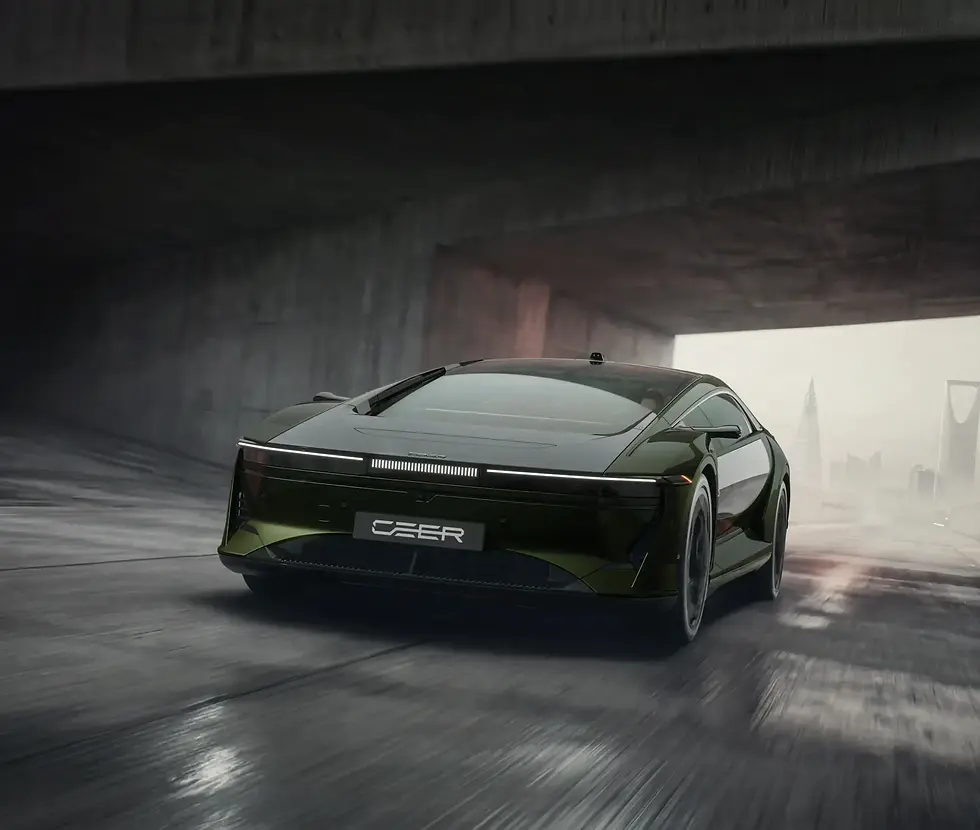
The cars have also been developed around the conditions in which they will actually operate. Extensive glazing presents an obvious challenge in the Saudi summer, so CEER has incorporated specialized glass and a high-capacity cooling system intended to bring cabin temperatures down rapidly.
The technology and performance are attention-grabbing, but the larger test for CEER will not take place on a launch stage.
It will happen on Saudi roads.
For decades, the Kingdom's automotive ambitions have repeatedly reached the point of prototypes, partnerships or assembly operations without developing into a fully established national passenger-car industry. CEER now has the financial resources, international partnerships and industrial infrastructure that earlier projects lacked.
The company's first seven-model cycle will be the real measure of whether those ingredients can be converted into a sustainable automotive business. CEER plans to introduce five additional vehicles between 2028 and 2030, broaden its powertrain strategy and eventually expand beyond Saudi Arabia into regional markets.
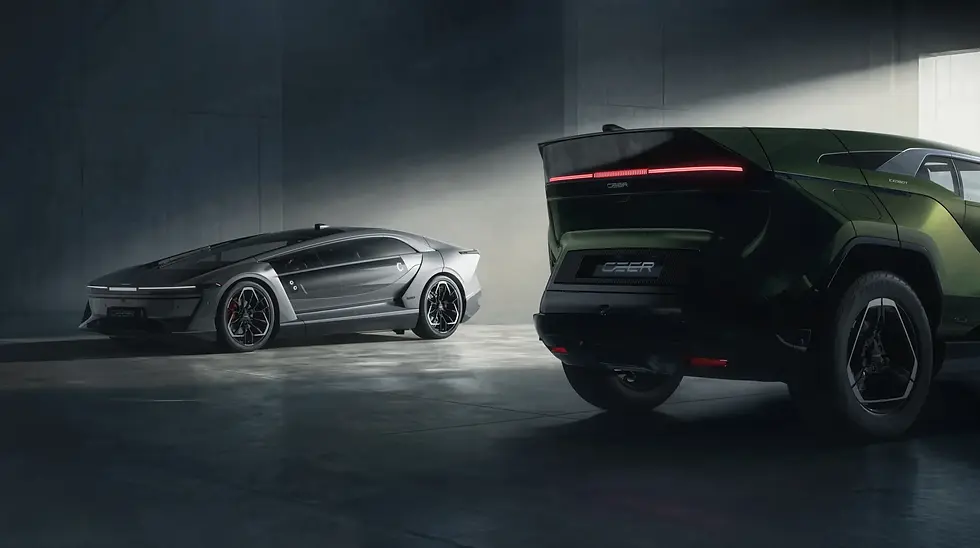
The EXOBOT, then, is not simply the first car from CEER. It is the most visible product of a much longer Saudi experiment with automotive manufacturing — one that began with assembling foreign trucks, moved through ambitious prototypes and partnerships, and has now reached the point where Saudi Arabia is attempting to create a car company of its own.
Follow us on:
Make sure to share this post and subscribe to our newsletter to receive notifications about our latest posts, exclusive content, and more!



Comments